

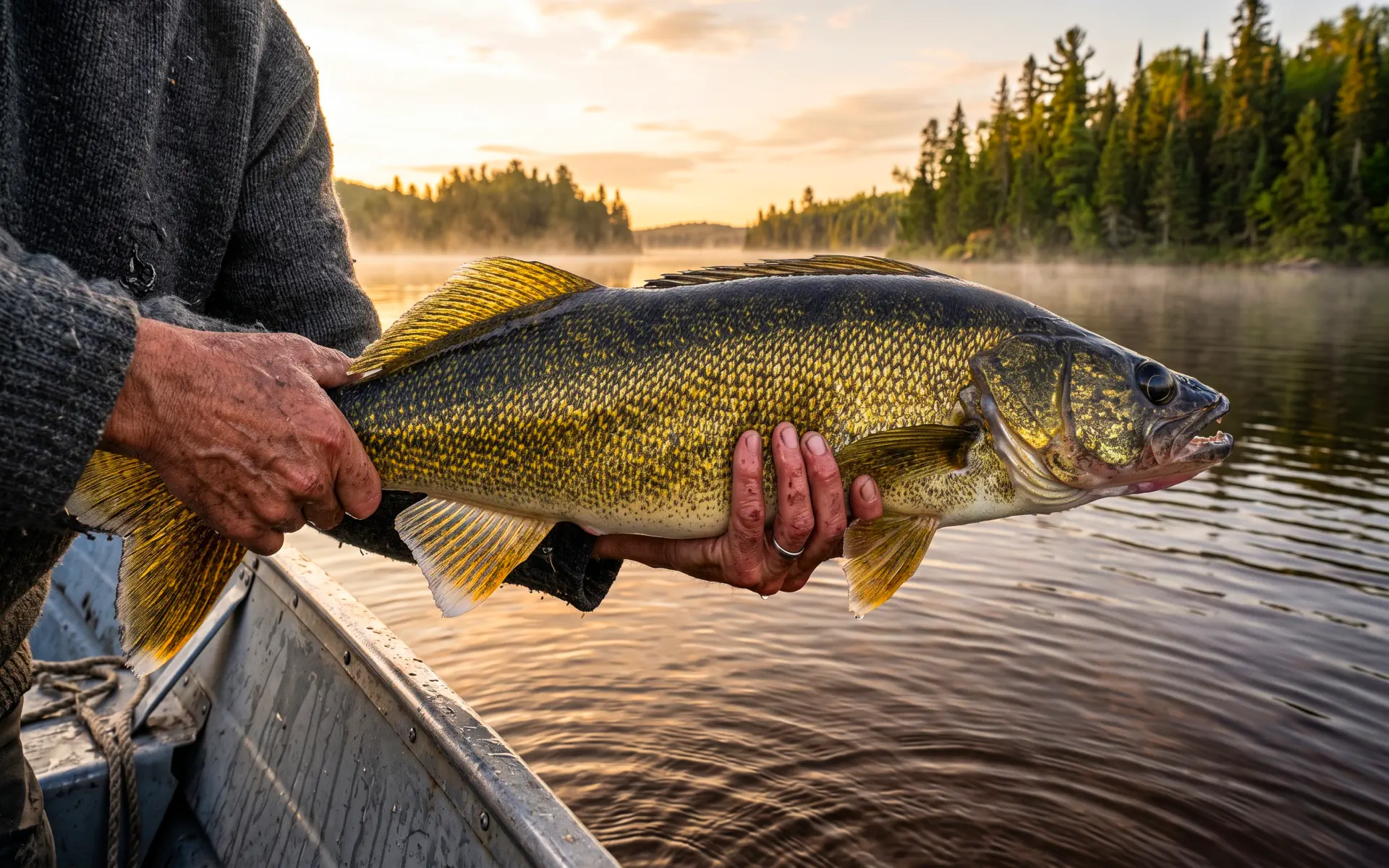
Understanding the Walleye Growth Rate
Explore the biological mechanics behind trophy walleye development—from early fry survival in Canadian Shield lakes to the caloric impact of cisco forage and latitude-driven longevity.
Walleye growth rates depend heavily on water temperature, latitude, and available forage. In northern waters, a walleye takes 3 to 4 years to reach 14 inches and 1 pound. While southern fish grow faster, northern walleyes live significantly longer—females can exceed 25 years and 40 inches. Trophy fish (28"+) are exclusively old females fueled by high-protein diets like ciscoes and yellow perch.
Interactive Walleye Growth Estimator
Estimate age, weight, and biological status based on length, region, gender, and primary diet.
Length vs. Age Growth Curve
Updates LiveThe Latitude Rule & Gender Divide
Geography and genetics dictate growth potential. Northern waters act as a natural biological preservative, while genetic limits cap male size.
Northern Manitoba Shield Lakes
- • Growth Velocity: Slow and steady (12-14" at Year 4).
- • Maximum Lifespan: Exceptional longevity (Up to 25–28 years).
- • Trophy Potential: High density of 28"+ females preserved by cold water.
Southern Reservoirs & Rivers
- • Growth Velocity: Rapid early burst (18" at Year 3).
- • Maximum Lifespan: Short lifespan (Rarely exceeds 8–10 years).
- • Trophy Potential: Fast early weight gain but lower overall trophy depth.
The Biological Gender Wall
Male walleyes hit a genetic wall around age 6 to 8. In northern waters, males top out around 20 to 22 inches and 3.5 pounds.
Females continue expanding both in length and girth year after year to produce viable egg batches in cold water.
Fry Gauntlet & High-Octane Forage
A walleye's life starts with a sprint against starvation in spring. Prey selection determines whether a fish stays average or becomes a heavy trophy.
Simulate Spring Fry Survival
Microscopic fry rely on zooplankton. Late cold fronts crash blooms, driving massive first-year mortality.
Forage Caloric Density Comparison
Adult walleyes cannot sustain massive body mass on insects alone. High-fat pelagic Ciscoes deliver maximum caloric density.
Catch & Release Ecological Impact
Because northern walleyes grow slowly over two decades, releasing a 28-inch female preserves twenty years of genetic adaptation.
The Shore Lunch Policy
At Cobham River Lodge, we harvest only smaller "eater" walleyes (14 to 18 inches) for shore lunch. Releasing trophy females ensures our remote watershed maintains its high-density giant walleye genetics for decades to come.