

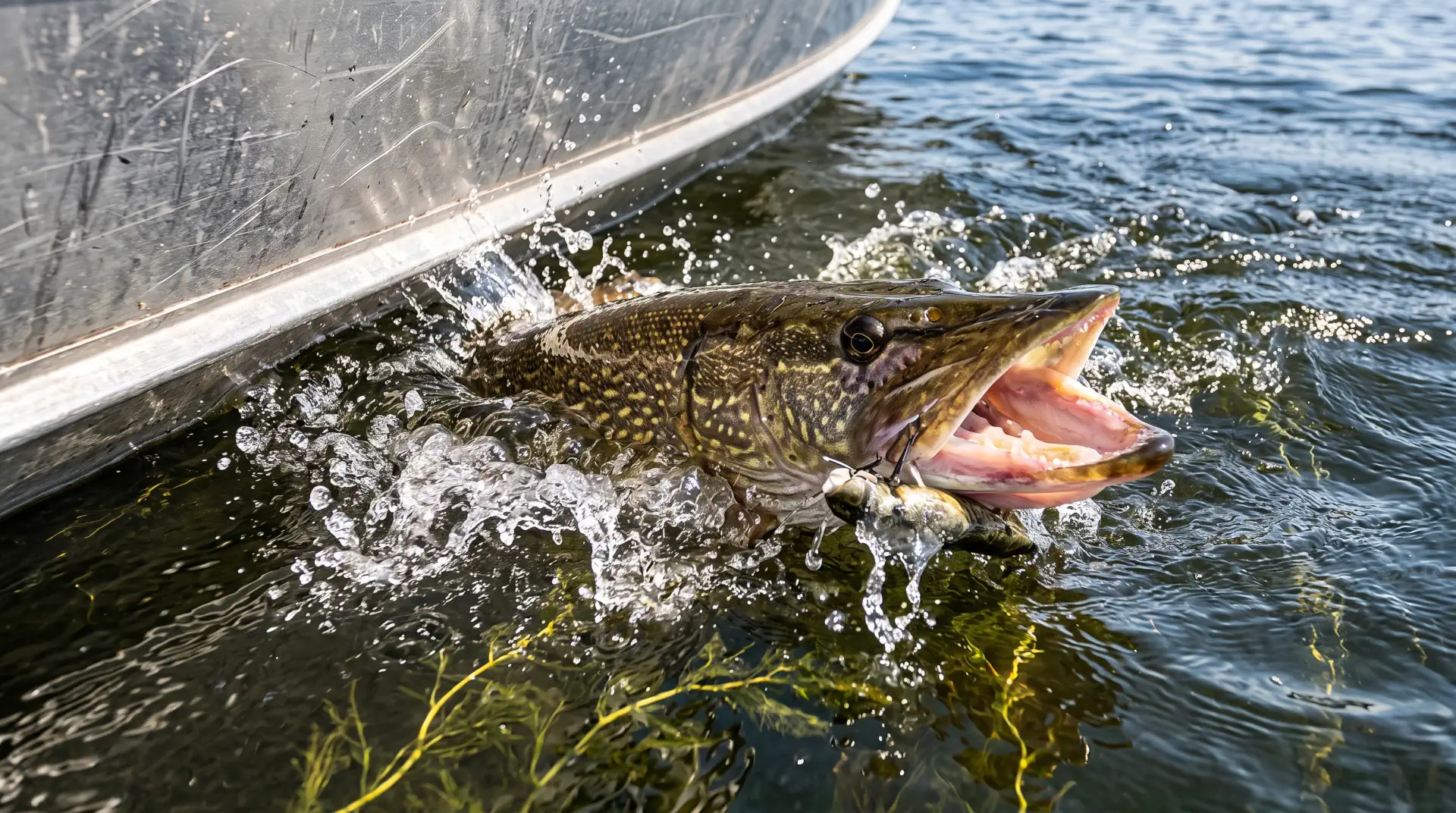
Quick Answer: Where to Find Northern Pike
To consistently locate northern pike, target water temperature, weed species, and depth transitions rather than blind casting shorelines. In spring, pike concentrate in shallow, dark-bottom bays between 2 and 6 feet. As summer temperatures rise above 65°F, mature trophy pike slide out to cabbage weedlines (8 to 14 feet), deep rock saddles, and main-lake reefs (15 to 30 feet) holding pelagic baitfish.
Water Temperature & Pike Depth Simulator
Adjust the lake surface temperature below to observe how mature trophy females shift deep into cool water while juvenile "hammerhandles" remain trapped in warm shallow bays.
Sliding off shallow flats to primary broadleaf cabbage lines and drop-offs.
Remaining in warm shallow muck chasing baby perch and minnows.
Ripping cabbage edges or slow-rolling deep rock edges adjacent to basins.
Depth Distribution vs. Thermal Comfort Zone
The Seasonal Playbook: Month-by-Month Movement
Trophy northern pike are migratory apex predators within their lake system. Select a season below to view the structural highway and exact holding positions.
Anatomy of Deep Structure
Big pike demand clean ambush angles, cool water, and high-energy food. Explore the four premier deep-water structures where 40-plus-inch fish stack up.
Broadleaf Cabbage Lines
Depth: 8 – 14 FeetCrisp, bright green broadleaf cabbage adjacent to steep drops. Avoid slimy brown moss. Pike suspend vertically along cabbage walls facing open water.
Sunken Humps & Reefs
Depth: 12 – 18 Ft (Tops)Isolated underwater rock piles surrounded by 30–45 foot basins. Wind drives plankton and ciscoes across these humps, holding giant females on down-current edges.
Deep Rock Saddles
Depth: 15 – 25 FeetUnderwater bridges connecting two islands or main-lake points. Saddles funnel currents, baitfish schools, and roving pelagic predators into tight squeeze points.
River Neck-Downs
Depth: 10 – 22 FeetConstriction points where river current feeds into deep basins. Pike tuck behind massive boulder seams, letting injured walleye and suckers drift right to them.
Forage Tracking: High-Calorie Targets
Trophy pike do not choose summer habitat based on scenery—they live where calories are high and exertion is low. In northern wilderness lakes, oil-rich pelagic species like ciscoes (lake herring) and lake whitefish fuel 40+ inch growth.
Relative Caloric Density & Holding Depth
Interactive Sonar Simulator
Learn to distinguish deep drop-offs, suspended cisco bait balls, and solitary trophy pike arches on your sonar screen.
Reef Edge Breakdown
Sharp contour lines dropping from 12 ft to 30 ft. Thick solitary arches hovering just off the slope indicate hunting female pike positioned under suspended ciscoes.
- Dense Cloud: Schooling ciscoes or whitefish.
- Heavy Large Arch: Apex predator (38"+ Pike).
- Hard Bottom Return: Red/Yellow thick bottom band.
The Guide's Release Protocol
A 42-inch female pike can be 15 to 20 years old. Proper handling ensures these ancient predators stay in the water column for generations.
Never Hold Vertically
Never hoist a heavy pike vertically by the gill plate or jaw. Their internal organs and vertebrae cannot support their body weight out of the water.
Rubberized Nets Only
Use large, knotless rubber mesh nets resting in the lake while unhooking. Knotted nylon strips away the slime coat, leaving fish vulnerable to infection.
Horizontal Cradle & Flare
Support the belly horizontally beneath the surface. Hold her steady until her gills flare with cold water and her tail kicks away into the dark depths.